A 65-year-old Canadian dentist presented in my practice with fourth-degree root caries in tooth 26 (upper left first molar).
A distal-occlusal restoration was placed, also extending into the root region. The pulp was not opened during the excavation. Ten weeks later, after a sudden progression of the symptoms, the decision was taken to perform a root canal treatment, and the patient was referred to an endodontist.
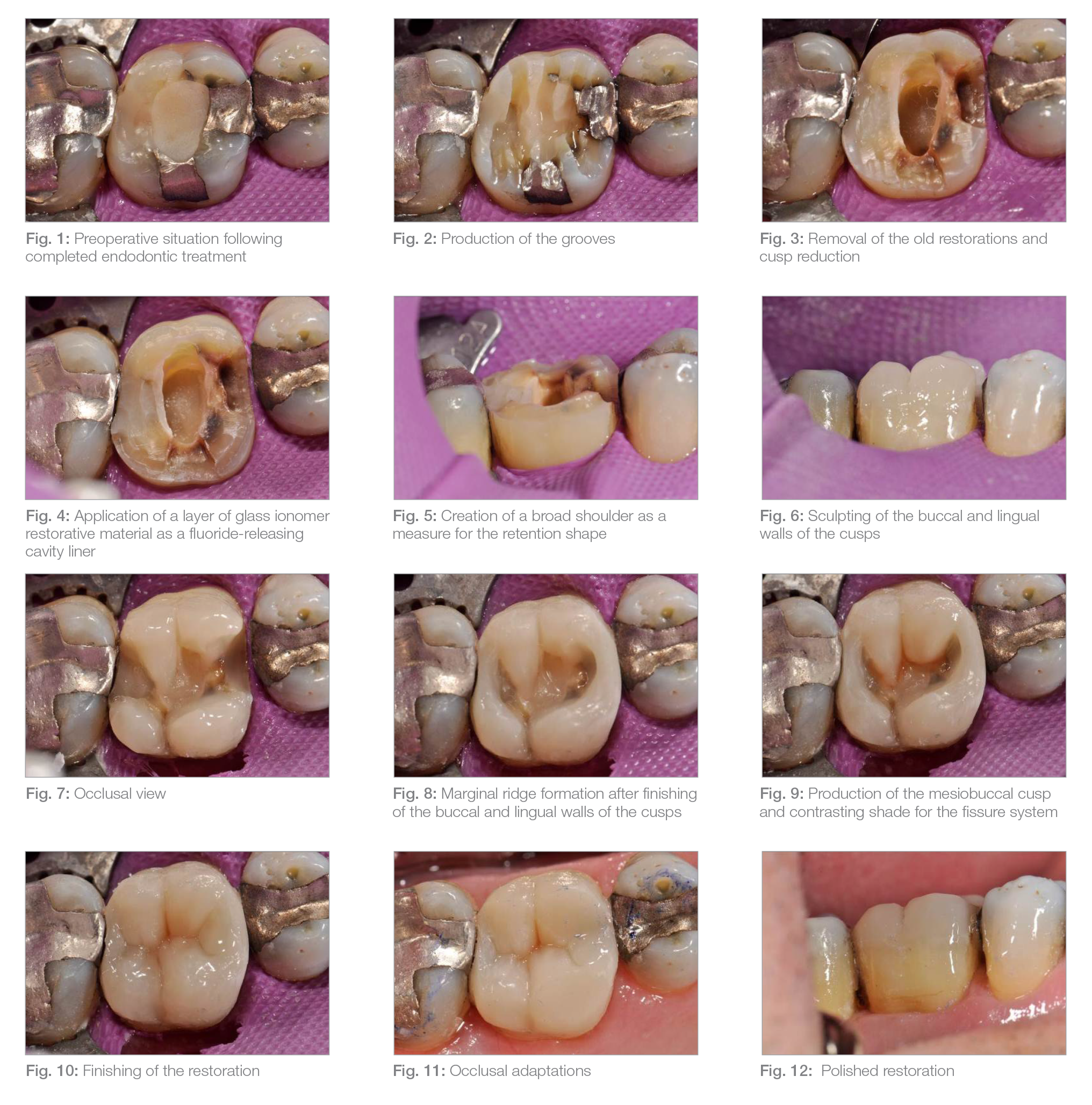
Once the endodontic treatment and temporary restoration were complete, the patient presented in the practice again for further treatmentFig. 1. The patient requested a restoration made of a composite with optimal mechanical properties so that the coronal structure is stabilised, the cusps covered and thus reinforced, and as much of the pericervical dentine as possible is preserved, as this factor ultimately determines the fracture resistance and prognosis of a tooth.
In order to achieve the layer thickness required for this type of restoration, an occlusal reduction of 2 mm is required to ensure the longevity of the composite restoration. This was done by firstly producing grooves as depth markingsFig. 2, then removing the temporary restoration and the old amalgam restorations and finally reducing the occlusal surfaceFig. 3,4.
To seal the pulp chamber, a layer of glass ionomer restorative material was applied as a fluoride- releasing, protective liner. Then just a shoulder measuring 1 mm in depth and 1.5 mm across was prepared all around the toothFig. 5.
This method allowed preservation of all the remaining pericervical dentine, with the result that the tooth still possesses high fracture resistance even after endodontic treatment.
Following micro air abrasion with 27 μm aluminium oxide, the tooth was etched for 15 seconds with 33% orthophosporic acid so as to create an even larger bonding surface. Futurabond U (VOCO) was then applied and massaged in for 20 seconds so as to achieve maximum wetting and consequently adhesion of the filling.
Technology
The buccal and lingual walls of the cusps were sculpted using the nanohybrid composite GrandioSO (VOCO) in A3 shade and placed by hand first of all, with the height of the neighbouring cusps being used as a referenceFig. 6. Figure 7 shows theocclusal view of the initial buccal and lingual cusps and the preliminary formation of the ridge between the distobuccal and mesiopalatal cusps, which will later be angled. The marginal ridges are formed with a sectional matrix system only when the buccal and lingual walls of the cusps are finished. A class I restoration is producedFig. 8. The mesiobuccal cusp is finished and the fissures are given a contrasting shadeFig. 9.
The restoration is completed with successive cusp formation on the central mesial, mesiopalatal and distopalatal sides (Fig. 10). Finally, occlusal adaptations are performedFig. 11 before the restoration with its five cusps is polished and finishedFig. 12.
Material discussion
Selection of bonding agent: Futurabond U (VOCO). This eighth-generation bonding agent is characterised by outstanding shear strength and is suitable for a range of applications: total etch, selective etch and self-etch. It has dual-curing properties, meaning that no separate activator needs to be added for dark curing (self-cure). Even after thermocycling, the bond to enamel is significantly better than with comparable products and achieves a remarkable 33.8 MPa in the thermocyclic self-etch technique. The bond to dentine is also notable, and even in the thermocyclic self-etch technique is a full 8 MPa higher than with a conventional alternative.
Selection of composite: GrandioSO (VOCO), shade A3. GrandioSO was selected for its excellent flexural strength of 187 MPa, which is considerably higher than that of dentine (165.6 MPa). Even after thermocycling, it is very biomimetic, at 158 MPa. As the material is employed in a region subject to very high loads, its compressive strength is decisive for avoiding cohesive compression shear fractures.
At 439 MPa, it is far higher than that of enamel (384 MPa) and also dentine (297 MPa). The microhardness of the surface and abrasion resistance are two further factors which ensure that the surface remains intact for as long as possible. The surface hardness of GrandioSO is almost twice as high as that of the other composites tested (Behrend, D., University of Rostock, 2010), and at 211 MHV is very close to natural enamel, which has a surface hardness of 350-450 MHV.
It proved possible to use just a single shade (A3) for the entire restoration, as its properties and the high filler content permit an outstanding chameleon effect.
Conclusion
The end result is an extraordinarily stable, direct acrylic restoration, which protects the underlying, damaged tooth structure and, thanks to the strong bond and its physical properties, possesses considerable durability. In addition, it enables great aesthetics.
View on the Henry Schein Web Shop
Article Published Jul-Sep 2023 Dental Solutions